The Heart of a Mechanical Watch: The Perfect Dance of the Balance Wheel and Hairspring
In the intricate world of mechanical watchmaking, one pair of components truly stands out as the “heart” of the movement: the balance wheel and the hairspring. Although they appear simple, their flawless coordination governs the rhythm of time. For instance, imagine the movement as a symphony orchestra—the balance wheel serves as the steady drummer, while the hairspring acts as the metronome precise to the microsecond. Neither can function effectively without the other; consequently, any imbalance quickly disrupts the entire timing accuracy of the watch.
The Balance Wheel: The Pendulum of Time
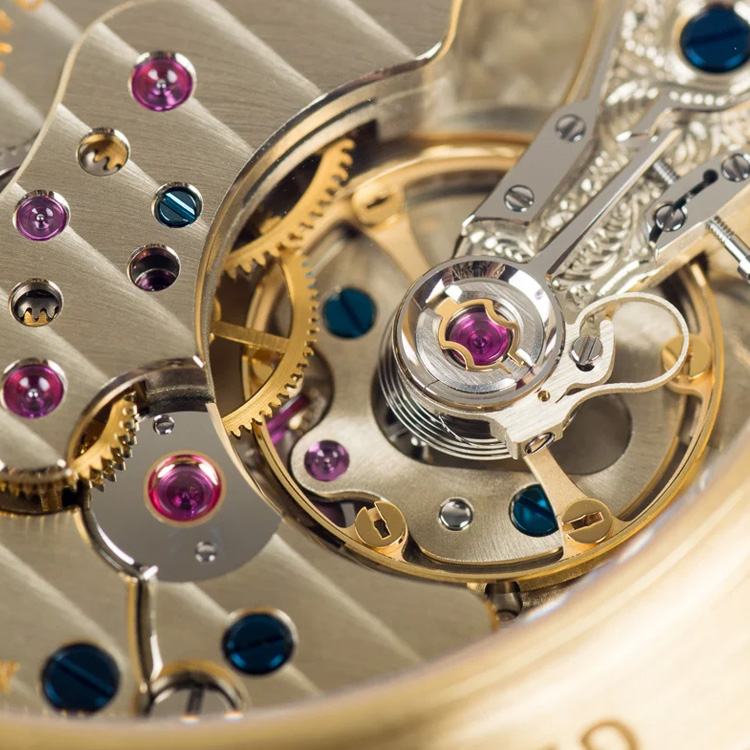
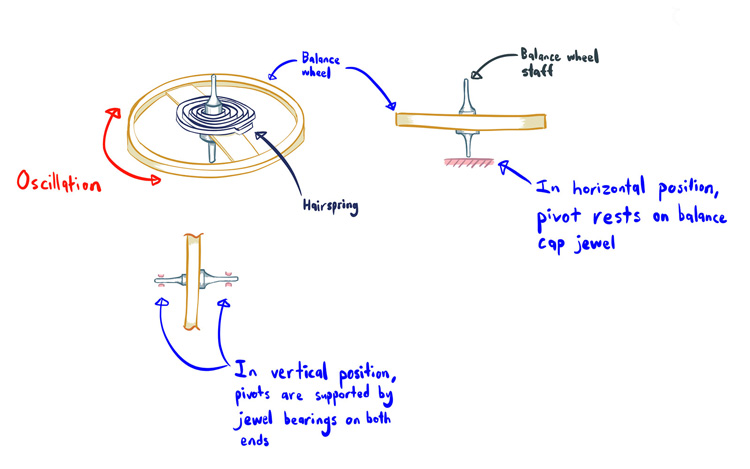
The balance wheel is a carefully weighted metal disc, typically crafted from copper alloys or Glucydur (a beryllium-bronze alloy). It oscillates back and forth on a staff pivot, and each full left-right swing forms a complete oscillation cycle. In addition, modern mechanical watches predominantly use free-sprung systems, where the wheel measures 8–12 mm in diameter and is precisely weighted to ensure uniform inertia.
However, the balance wheel alone cannot sustain regular motion. Instead, it relies on a consistent restoring force to drive its repeated swings. This is precisely where the hairspring takes center stage.
The Hairspring: The Invisible Metronome
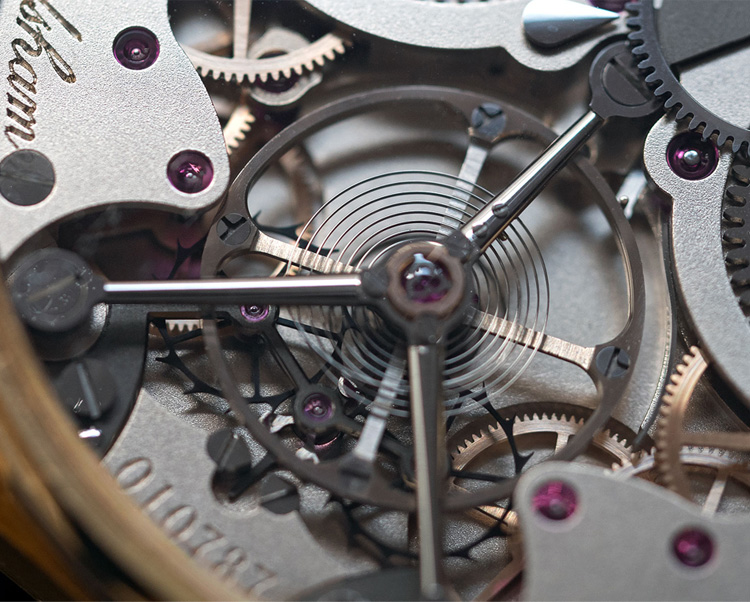
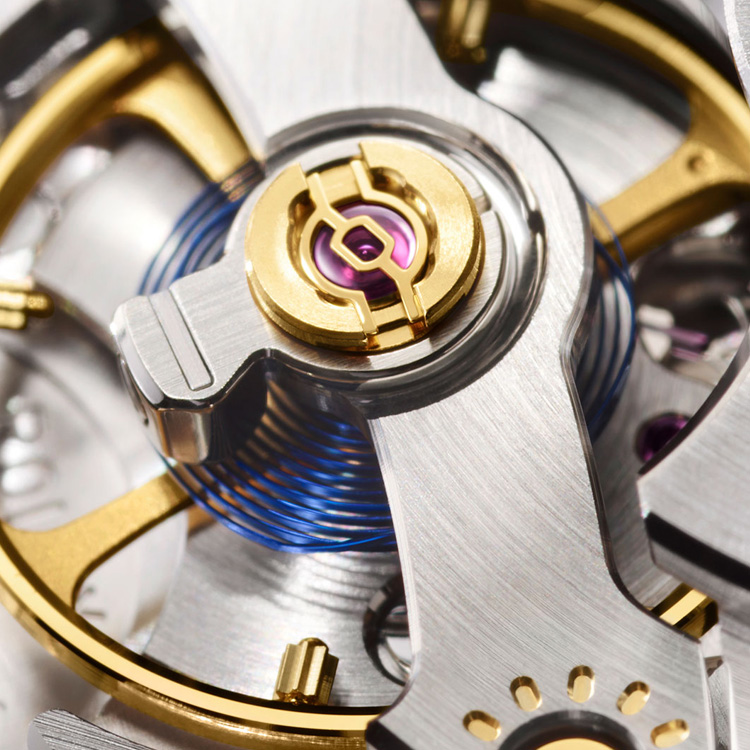
The hairspring—also known as the balance spring—is an ultra-thin spiral wire. Traditionally, it is made from Nivarox (a nickel-chrome alloy), though modern versions increasingly use silicon. Remarkably, it stretches roughly 30 cm in length yet measures only 0.03–0.05 mm in diameter, enduring tens of thousands of contractions and expansions every day.
One end attaches to the balance cock stud, while the other secures to the balance wheel’s collet. When the wheel swings away from equilibrium, the hairspring generates an elastic restoring force to pull it back. Then, inertia carries it past center, and the hairspring pulls in the opposite direction—thus creating continuous, ideally isochronous oscillation.
Key formula: Oscillation frequency f ≈ √(I / C) where I represents the moment of inertia of the balance wheel, and C denotes the stiffness coefficient of the hairspring. Consequently, a higher frequency results in a faster beat rate (most modern watches operate at 28,800 vph, or 4 Hz).
Their Precise Relationship: The Soul of Isochronism
The partnership can be summarized simply: the hairspring determines the frequency, the balance wheel provides inertia, and together they ensure isochronism—consistent timing regardless of amplitude.
- Concentricity: The hairspring must breathe perfectly centered; otherwise, any eccentricity leads to positional errors.
- Flatness: Moreover, the spiral must remain planar to minimize gravitational influence.
- Temperature compensation: Traditional Nivarox expands or contracts with heat changes; therefore, solutions include bi-metallic wheels or silicon, which is virtually immune to temperature variations.
- Anti-magnetism: Steel hairsprings magnetize easily; in contrast, silicon is inherently non-magnetic and resists up to 15,000 gauss.
Even a 0.01 mm mismatch can produce daily errors of tens of seconds. For this reason, master watchmakers spend hours under microscopes “poising and vibrating” the hairspring—this critical step ultimately determines whether the movement achieves chronometer precision (COSC standard: –4/+6 seconds per day).
Modern Innovation: The Silicon Hairspring Revolution
Since the early 2000s, silicon hairsprings have entered mainstream production (used by Patek Philippe, Rolex, Omega, and the Swatch Group):
Advantages: Non-magnetic, rust-proof, lightweight, consistent stiffness, near-zero thermal coefficient.
Notable movements:
Omega 8500/9300 Co-Axial (Si14 silicon spring)
Rolex Caliber 3235 (blue Parachrom spring + Chronergy escapement)
Breguet Tradition series (silicon spring + silicon escapement)
Silicon has made mechanical watches far more stable in everyday conditions, bringing “anti-magnetic” and “shock-resistant” performance to accessible price points.
Conclusion: The Romance of Time Lies in Delicate Balance
Every smooth sweep of the seconds hand stems from the balance wheel and hairspring dancing silently tens of thousands of times each day. Without batteries or chips, they rely solely on pure physics to guard time. Ultimately, this is the enduring magic of mechanical watches: within a tiny space lies humanity’s profound pursuit of precision and eternity.
Which do you prefer—the classic charm of traditional Nivarox hairsprings or the modern reliability of silicon? Feel free to share your thoughts in the comments!