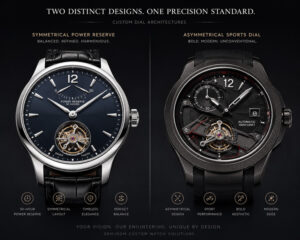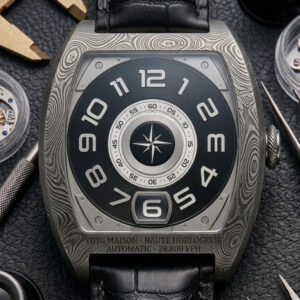
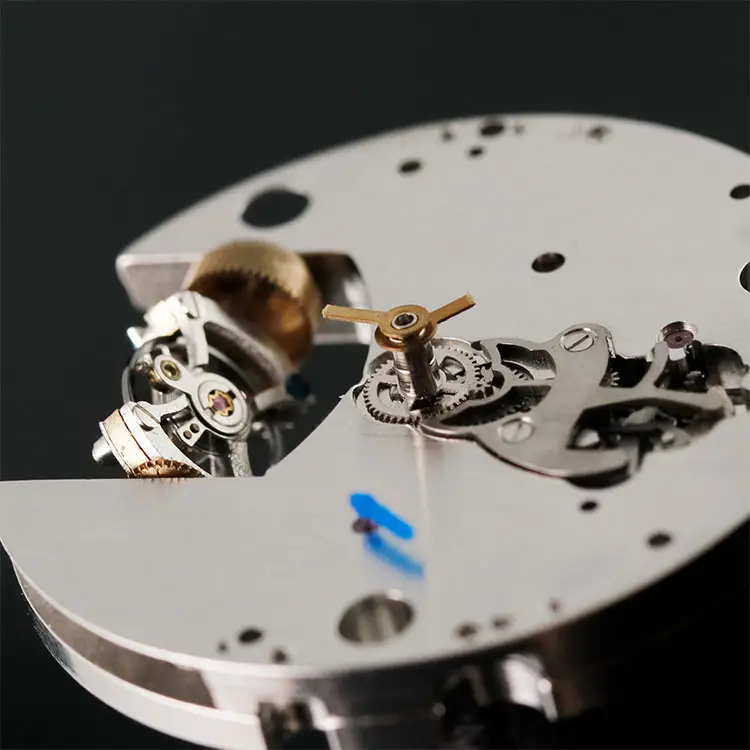
For decades, the watch industry relied on a limited number of mass-produced base movements. However, the landscape has shifted dramatically. Today, discerning brand owners and serious collectors increasingly value the in-house movement watch as the ultimate symbol of prestige.
More importantly, true luxury no longer depends solely on dial aesthetics or case finishing. Instead, it reflects mechanical watch independence. Therefore, brands must move beyond simple assembly and embrace full manufacturing capability. To achieve this, they need a strong commitment to vertical integration and complete control over every microscopic component within the caliber.
1. Defining the Manufacture: What Is a True In-House Movement?
Beyond the Label
A “Manufacture” movement refers to a caliber that a brand designs, develops, and assembles internally. However, while many brands claim this status, only a few achieve true autonomy.
In fact, a genuine in-house project starts from scratch. Engineers must define the gear train ratios, optimize power reserve torque, and design the bridge architecture from the ground up. As a result, brands gain full control over performance and structure.
Proprietary Calibers as a Strategic Advantage
Unlike standard movements, proprietary calibers deliver exclusivity. They cannot be sourced from competitors, which immediately strengthens brand differentiation. Consequently, they become a powerful USP in a saturated market.
Vertical Integration: From Raw Metal to Precision Mechanism
At the same time, vertical integration transforms production capability. The process begins in the machining workshop, where CNC systems mill brass plates to micron-level tolerances. Then, each component undergoes strict internal validation.
Because of this, brands ensure perfect alignment, higher efficiency, and consistent chronometric performance across all movements.
2. The Technical Frontier: Escapement Manufacturing
The Soul of the Watch
Among all components, the escapement defines the true technical barrier. Specifically, producing the hairspring, balance wheel, and pallet fork requires advanced metallurgy and extreme micro-engineering.
Therefore, only a limited number of manufacturers can achieve full escapement independence.
Precision Control and Regulation
By mastering escapement manufacturing, brands gain full control over the watch’s “heartbeat.” As a result, they can fine-tune performance across different temperatures and positions.
Furthermore, this control allows movements to meet or exceed ISO 3159 standards. Consequently, end users benefit from highly reliable and precise timekeeping.
3. In-House vs. Outsourced Movements
The difference between outsourced and proprietary movements extends beyond branding. In fact, it directly impacts performance, flexibility, and long-term value.
- Exclusivity: Outsourced movements appear across multiple brands, while in-house calibers remain unique.
- Design Freedom: Standard movements limit layout options; in contrast, proprietary designs enable custom complications.
- Quality Control: Third-party production follows external standards, whereas in-house systems ensure 100% internal inspection.
- Finishing: Industrial finishing cannot match hand-applied techniques such as anglage or perlage.
- Precision: Base movements typically achieve ±15 sec/day; however, in-house calibers can reach chronometer-grade accuracy.
4. Why Brand Owners Invest in Custom Watch Movements
Market Differentiation
First of all, a custom watch movement protects brands from market homogenization. Instead of competing on design alone, they compete on engineering excellence.
Bespoke Aesthetics
Moreover, in-house production enables unique visual identities. Brands can develop custom bridge shapes, skeletonized layouts, and signature movement architecture. As a result, the watch reflects a cohesive brand DNA.
Long-Term Serviceability
Equally important, controlling production ensures a stable supply of spare parts. Therefore, brands can guarantee long-term service support—an essential factor for high-end customers.
5. Craftsmanship Meets Engineering
Although CNC machining ensures precision, craftsmanship defines value. Skilled watchmakers apply hand-finishing techniques such as Côtes de Genève and polished anglage.
As a result, each movement combines industrial accuracy with artisanal refinement. This balance ultimately defines modern mechanical independence.
Conclusion: The Future of Independent Watchmaking
In conclusion, the rise of in-house movement watches signals a return to true horological values. On one hand, brands gain technical control; on the other hand, they strengthen identity and long-term competitiveness.
Therefore, mechanical independence is no longer optional—it is essential.
Build Your Own Caliber
Stop relying on generic movements. Instead, start building your own legacy.
As a professional watch manufacturer, we provide end-to-end support—from R&D and prototyping to chronometric testing. Together, we can help you achieve full independence and create a truly proprietary caliber.
👉 [CONSULT WITH OUR MOVEMENT ENGINEERS] https://watcheshome.com/